

Author: Craig Medlin
Organization: CRAIGS LLC
Version: 1.0 Release Draft
Current Status: Observed implementation with a single user.
Validation: Microsoft Copilot + Work IQ + OneDrive.
Replication: Not yet independently reproduced.
Supporting development records, retrieval tests, and operational observations are preserved within the Reasoning Corpus. This whitepaper summarizes the resulting architecture and findings without requiring access to those internal records.
Executive Summary
Most digital systems preserve outcomes. They preserve emails, reports, presentations, photographs, documents, and final decisions.
What they often fail to preserve is the reasoning that produced those outcomes.
The Reasoning Corpus is a personal knowledge-preservation system designed to preserve observations, questions, interpretations, corrections, insights, and conclusions as they develop over time.
During development, an unexpected observation emerged. Procedures documented within the corpus were sometimes surfaced through repository retrieval before they were consistently reproduced through conversational continuity alone. This suggested that continuity may emerge from retrieval of preserved artifacts rather than memory alone.
The system combines:
AI-assisted reasoning
Voice-first journaling
Structured metadata
Markdown preservation
Microsoft OneDrive
Microsoft Copilot
Work IQ grounding within Microsoft Copilot
The objective is not merely information retention.
The objective is continuity of understanding.
What did I know, when did I know it, why did I believe it, and how did that belief change?
1. The Problem
Human memory is incomplete.
Traditional archives suffer from a different limitation. They may preserve conclusions while losing:
Context
Reasoning
Corrections
Uncertainty
Competing interpretations
Intellectual development
Years later, a person may remember a conclusion but forget the reasoning that originally supported it.
This creates several challenges:
Loss of rationale
Hindsight distortion
Broken continuity
Difficulty reconstructing decisions
Difficulty tracing idea evolution
The corpus was created in response to that problem. A foundational observation emerged early:
Preserved context ≠ Retrieved context
Information exists ≠ Information is visible
Storage alone does not guarantee retrieval. Retrieval alone does not guarantee understanding.
2. The Hypothesis
Reasoning can be archived.
If conversations, journals, corrections, reflections, and analyses are preserved with sufficient fidelity and metadata, future retrieval systems may reconstruct not only facts, but intellectual evolution.
Instead of preserving only:
Conclusion
the corpus attempts to preserve:
Observation
↓
Interpretation
↓
Challenge
↓
Correction
↓
Refinement
↓
Conclusion
The path may ultimately be more valuable than the destination.
3. Current Tested Environment
The Reasoning Corpus has been developed and observed in the following environment:
Microsoft Copilot
Microsoft 365
Microsoft OneDrive
Work IQ grounding within Microsoft Copilot
Markdown files
Structured metadata
Direct-download ingestion
Voice-first journaling
Work IQ was active in the Microsoft Copilot environment in which the corpus was developed and tested. This paper does not evaluate Work IQ independently or claim that Work IQ alone produced the observed retrieval results.
3.1 Validation Boundary
The corpus has not been systematically tested using:
ChatGPT
Claude
Gemini
Local language models
Alternative cloud repositories
Alternative retrieval systems
Microsoft Copilot with Work IQ unavailable or inactive
Therefore, this paper does not claim universal portability, identical behavior across AI models, or equivalent retrieval quality outside the Microsoft ecosystem.
The Reasoning Corpus has demonstrated practical usefulness within the Microsoft Copilot, Work IQ, OneDrive, and Markdown environment in which it was developed.
4. Architectural Model
The corpus consists of six layers.
Layer 1: Primary Reasoning
Human-AI conversations provide raw reasoning material. Examples include:
Questions
Reactions
Interpretations
Corrections
Experiments
Emerging frameworks
New observations
The purpose of conversation is discovery. Conversation itself is not treated as the authoritative artifact.
Layer 2: Structured Handoffs
Significant conversations are converted into structured Markdown artifacts.
Filename convention:
YYYY-MM-DD_HHMM_Topic_Name.md
Example:
2026-09-30_1238_Corpus_Risk_And_Long_Term_Vision.md
The purpose of the handoff is not transcript preservation. The purpose is reasoning preservation.
Layer 3: Voice-First Journaling
The corpus includes personal journal entries created outside AI conversations.
Workflow:
Spoken reflection
↓
Mobile voice recording
↓
.m4a export
↓
.txt export
↓
Markdown conversion
↓
Corpus artifact
The recording application exports:
Audio (.m4a)
Transcript (.txt)
The transcript is converted into a structured Markdown artifact. Three preservation layers are maintained:
Audio
↓
Transcript
↓
Structured Markdown record
Each layer serves a different purpose. The original audio is the closest preserved form of the spoken entry. The transcript provides searchable text. The Markdown version adds structure, meaning, and retrieval cues.
Layer 4: Canonical Preservation Format
Markdown (.md) is the canonical textual preservation format.
Markdown was selected because it is:
Human-readable
Machine-readable
Searchable
Portable
Durable
Easy to migrate
Independent of proprietary software
Markdown is not merely a file format. It is a long-term preservation strategy.
Layer 5: Repository Preservation
The corpus is stored within a structured OneDrive repository.
Current architecture:
CHAT_HANDOFF_CORPUS
├── Archive
├── CANON
├── Derivatives
├── Indexes
├── Observations
├── Reference
└── Validation
Within CANON:
CANON
├── Essays
├── Journal
├── Milestones
├── Notes
└── Records
Within Records:
Records
└── YYYY
    ├── Active
    └── Foundational
The structure supports preservation, classification, validation, and retrieval.
Layer 6: Retrieval
The retrieval layer allows preserved records to participate in future reasoning. The objective is not merely finding files. The objective is reconstructing understanding.
Typical retrieval questions include:
When did this idea originate?
What evidence supported it?
When did I change my position?
Which discussions influenced this framework?
What objections were considered?
5. Canonical Artifact Formats
5.1 Chat Handoff
# Chat Handoff

Date:
Time:

## Primary Topic

## Why This Conversation Mattered

## Why This Matters

## Key Insights

## People

## Retrieval Keywords

## Key Outcomes

## Continuity Links
The Reasoning Corpus does not currently rely on formal graph relationships. Continuity emerges through overlapping retrieval signals including timestamps, retrieval keywords, metadata sections, continuity links, and repeated references. Together these elements create multiple retrieval paths to the same concepts.
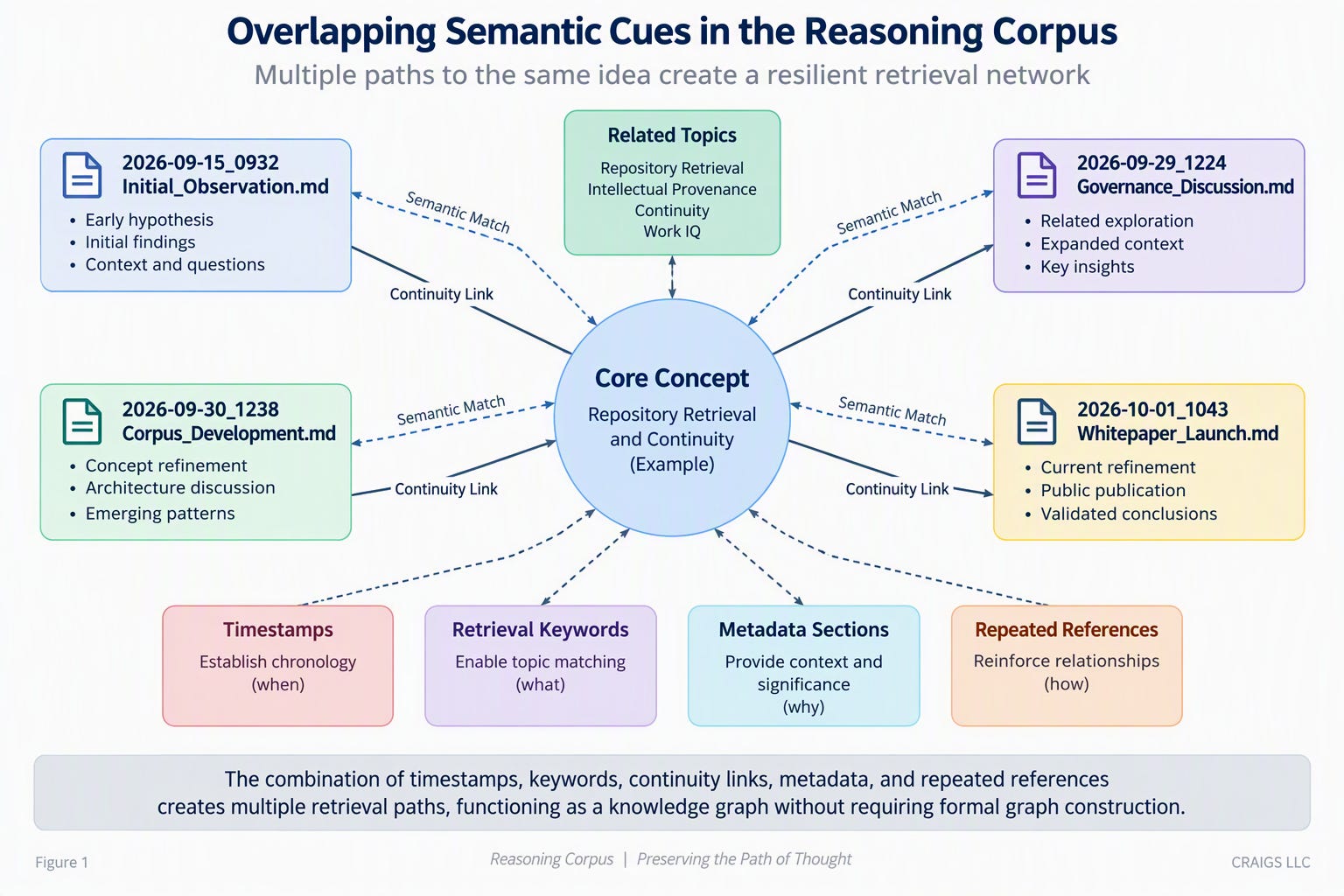
Figure A. Overlapping semantic cues create a graph-like retrieval structure without requiring explicit graph construction.
Why Two Significance Sections Exist
“Why This Conversation Mattered” explains why the specific discussion was preserved.
“Why This Matters” explains the broader lesson or implication.
The first preserves the event. The second preserves the principle.
5.2 Journal Entry
# Journal Entry

Date:
Time:
Source:
Original Audio:
Original Transcript:

## Primary Topic

## Summary

## Main Reflections

## Key Observations

## Notable Statements

## Retrieval Keywords

## Related Topics

## Why This Entry Mattered

## Why This Matters
Chat handoffs preserve reasoning developed through dialogue. Journal entries preserve reasoning captured through personal reflection.
6. Direct-Ingestion Workflow
One of the simplest improvements was changing the browser’s default download location to a folder inside the synchronized corpus.
Original workflow:
Copilot
↓
Download
↓
Downloads folder
↓
Manual move
↓
Corpus
Optimized workflow:
Copilot
↓
Download
↓
Corpus
↓
OneDrive sync
↓
Retrieval surface
Benefits include:
Reduced friction
Fewer manual steps
Faster synchronization
Lower probability of misplaced records
More consistent archival behavior
7. Core Design Principles
Record Fidelity
Record fidelity is more important than organization. An imperfect filename may be inconvenient. An incomplete record may be misleading.
The greatest risk is degradation of:
Context
Chronology
Corrections
Provenance
Reasoning pathways
Intellectual Provenance
The corpus preserves:
Evidence
Questions
Challenges
Corrections
Alternatives considered
Context
Evolution of understanding
The objective is to preserve how conclusions emerged.
Human-Readable Authority
AI retrieval is useful, but the AI is not the authority over the record.
For chat handoffs, the preserved Markdown record is the canonical textual artifact. For journal entries, the Markdown record is the canonical retrieval artifact, while the original audio and transcript remain supporting source records.
Lightweight Metadata
The corpus depends on a small set of stable metadata fields:
Topic
Significance
Insights
Keywords
Outcomes
Continuity
The metadata exists to preserve meaning, not bureaucracy.
Retrieval Over Recall
The corpus is built on a practical observation:
Reliable retrieval may be more valuable than perfect memory.
8. Observed Challenges
Downloadability Drift
A recurring issue involved generation of handoff content without generation of a downloadable Markdown artifact.
Repeated correction was required:
“Downloadable please.”
The lesson:
Correct content ≠ Completed artifact
Naming Drift
Naming conventions evolved over time. Although retrieval continued to function, inconsistency created:
Visual noise
Additional review effort
Reduced predictability
This reinforced the value of a standardized naming convention.
Metadata Drift
Required sections were occasionally omitted or applied inconsistently. The distinction between Why This Conversation Mattered and Why This Matters was one example.
Instruction Retention Variability
Procedures agreed upon in prior conversations were not always applied consistently. Examples included:
Missing downloads
Missing metadata sections
Naming inconsistencies
This produced an important lesson:
Conversational agreement is not a reliable process-control mechanism.
Standards should exist inside retrievable records.
Indexing Delay
The system must distinguish:
File created ≠ File synced ≠ File indexed ≠ File retrieved
A file may exist before it becomes discoverable.
Survivor Bias
The corpus preserves what was recorded. It does not preserve everything that occurred. Future readers must not confuse archived history with complete history.
9. The OneDrive Context Revelation
One of the most interesting findings emerged when repository retrieval surfaced context before conversational continuity reproduced it reliably.
The informal observation became:
“OneDrive remembered first.”
This should not be interpreted literally. The evidence supports a narrower conclusion:
Repository retrieval sometimes recovered documented procedures before conversational continuity consistently reproduced them.
Conceptually:
Conversational continuity
=
What remains available in the conversation
Repository retrieval
=
What can be rediscovered from preserved artifacts
This may be one of the most important architectural findings of the corpus. The archive became part of the cognitive system.
Craig ⇄ AI

evolved into

Craig ⇄ AI ⇄ Corpus
The corpus stopped functioning solely as storage. It began functioning as continuity.
10. Long-Term Vision
The Reasoning Corpus is not intended to become a database of answers. It is intended to become a historical record of thought.
If maintained for decades, it may preserve:
Origins of ideas
Changes in belief
Failures
Corrections
Framework development
Personal reflections
Intellectual milestones
Evolution of language
Evolution of understanding
Most archives preserve conclusions. The Reasoning Corpus attempts to preserve the path.
Its value may not be helping someone remember what they knew. Its value may be helping someone understand how they came to know it.
Key Findings
1. Reasoning can be preserved as a retrievable artifact.
2. Retrieval quality depends heavily on record fidelity.
3. Markdown provides a practical long-term preservation format.
4. Repository retrieval sometimes restored context before conversational continuity reproduced it.
5. Continuity may emerge from preserved artifacts rather than memory alone.
Conclusion
The Reasoning Corpus is an attempt to preserve a layer that is often lost: reasoning itself.
The implementation is technically simple:
Voice recordings
Transcripts
Markdown artifacts
Structured metadata
OneDrive storage
Microsoft Copilot retrieval
Work IQ-assisted context discovery
The complexity lies not in technology. The complexity lies in maintaining continuity.
The central finding to date is:
Reliable AI continuity does not necessarily reside inside the AI. It can emerge from faithful records that remain available for retrieval.
The corpus therefore functions as more than an archive. It functions as a reasoning-provenance system.
Its purpose is not perfect memory. Its purpose is continuity of understanding.