

Organizations today are investing heavily in AI governance, compliance frameworks, and data oversight.
But there’s a foundational problem being overlooked:
Can you prove your data hasn’t silently changed?
The Hidden Failure Mode: Record Drift
Across healthcare, law enforcement, and enterprise systems, critical records rarely live in one place.
They are:
Created in one system
Updated in another
Referenced across email, tickets, and conversations
Over time, something subtle happens:
The record drifts.
Not maliciously. Not even noticeably at first.
But eventually:
Timelines don’t align
Reports conflict
Details can’t be verified with certainty
And when that happens, organizations are forced into reconstruction instead of verification.
The Gap in Current Systems
Most organizations already have:
Systems of record (EHR, RMS, ticketing platforms)
Audit logs
Governance frameworks
But these systems answer:
“What does the data say now?”
They do not reliably answer:
“Can we prove what the data originally was?”
That distinction matters.
A Different Layer: Verification, Not Replacement
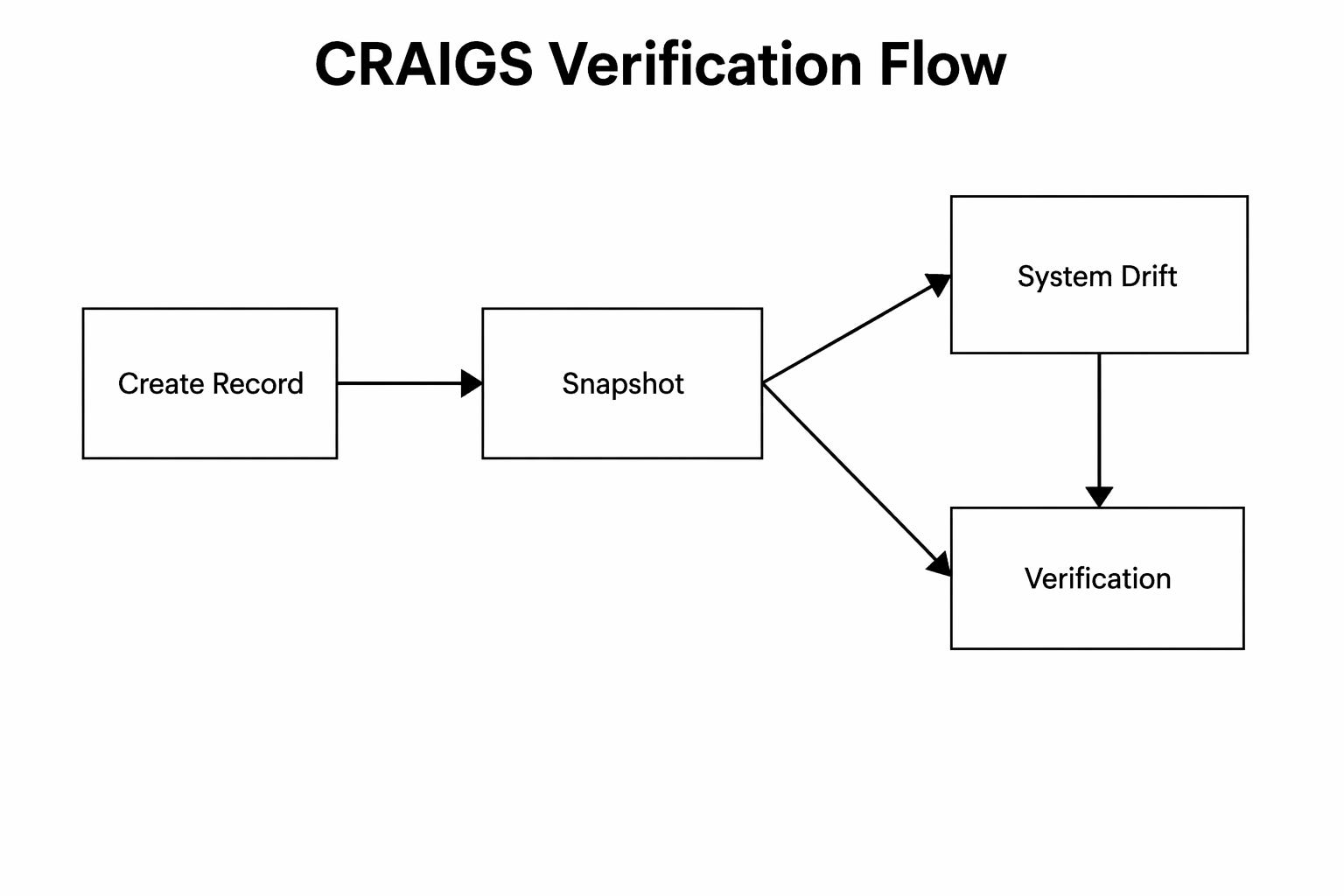
CRAIGS defines the requirement for a canonical reference point that can verify records without altering existing systems.
Instead of replacing workflows, it adds:
A separately verifiable canonical reference layer
A consistent method for detecting change
Independent verification of record integrity over time
From that moment forward, any version of that record can be compared back to its canonical origin.
What This Enables
Chain-of-Custody Integrity
It becomes possible to prove what a record contained at the moment it was created.
Dispute Resolution Without Reconstruction
When timelines or details are questioned, verification replaces guesswork.
Cross-System Consistency
Even if multiple systems touch the same record, there is only one verifiable baseline.
Legal & Compliance Readiness
Instead of rebuilding history, organizations can demonstrate it.
A Real Scenario
An incident is documented:
Initial report at 14:03
Updates added later
Referenced in multiple systems
At some point, a discrepancy appears.
Without a canonical baseline, the organization asks:
“Which version is correct?”
With a canonical baseline, the organization answers:
“Here is the original record, verifiably unchanged.”
Key Insight
CRAIGS is not another system of record.
It is a:
Layer of record verification
Why This Matters Now
As AI systems consume and act on organizational data, one question becomes critical:
If the underlying data drifts, what exactly are we governing?
Before we regulate how data is used…
We need to verify that it hasn’t silently changed.
Closing
This is not a future-state concept.
These conditions can be met without replacing existing infrastructure.
And it addresses a problem that most organizations don’t realize they have until it’s too late.